
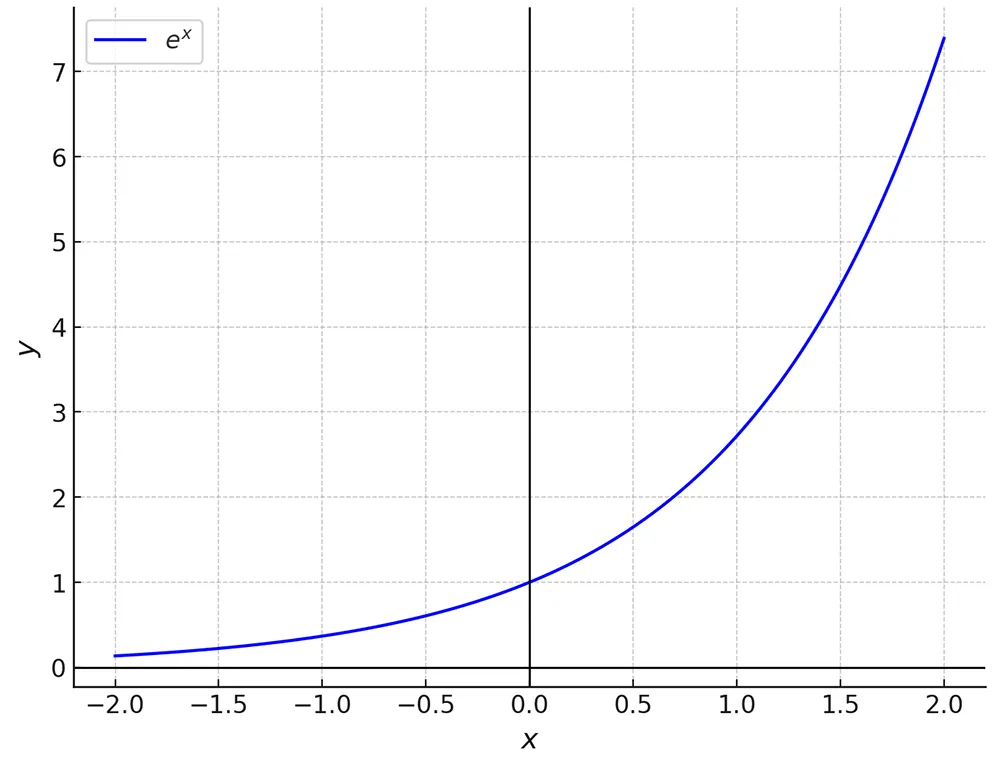
The exponential function is unique in calculus because it is the only function that is its own derivative. This property makes it extremely important in various fields like physics, economics, and engineering.
In order to find the derivative of \(e^x\), we can use the limit definition of the derivative:
\[ \frac{d}{dx}e^x = \lim_{h \to 0} \frac{e^{x+h} – e^x}{h} \]
\[ \Rightarrow \frac{d}{dx}e^x = \lim_{h \to 0} \frac{e^x (e^h – 1)}{h} \]
Since \(e^x\) is independent of \(h\), we can factor it out of the limit:
\[ \Rightarrow \frac{d}{dx}e^x = e^x \lim_{h \to 0} \frac{e^h – 1}{h} ~~~~~ (1) \]
We use the Taylor series expansion of \(e^h\):
\[ e^h = 1 + h + \frac{h^2}{2!} + \frac{h^3}{3!} + \dots \]
\[ \Rightarrow e^h – 1 = h + \frac{h^2}{2!} + \frac{h^3}{3!} + \dots \]
\[ \Rightarrow \frac{e^h – 1}{h} = 1 + \frac{h}{2!} + \frac{h^2}{3!} + \dots \]
As \(h \to 0\), all terms involving higher powers of \(h, h^2, h^3 …\) tend to zero
\[ \Rightarrow \lim_{h \to 0} \frac{e^h – 1}{h} = 1 \]
Thus, (1) becomes:
\[ \frac{d}{dx}e^x = e^x \]
Thinking about building an AI product?
Get in Touch